Showing posts with label Family Car. Show all posts

Honda CR-V Review

When the original Honda CR-V debuted in the late 1990s, its mission was simple: to offer a distinct alternative to more mainstream mid- and full-size large SUVs. With its car-based design, economical four-cylinder engine and sedanlike ride and handling, the CR-V was an instant hit. Priced competitively and offering plenty of passenger room and cargo capacity for most people's needs, the Honda CR-V has long enjoyed strong sales numbers and much loyalty from consumers.
Today, the compact- or small-SUV segment has grown to include more than a dozen different models, with varying philosophies of what constitutes the perfect blend of size, power and capability. While some models offer V6 engines and others can deliver true off-road capability, the Honda CR-V remains focused on its more practical aspirations. True to form, it is one of the best choices available in the all-important areas of being both easy to drive and family-friendly.
Current Honda CR-V
The CR-V was redesigned for 2012, making this the fourth generation of the model. Though hardware changes are minimal, there are enough style and feature changes to keep Honda's top-selling compact crossover fully competitive.
Essentially the same size as before, the CR-V is offered in familiar LX, EX and EX-L trim levels. Even the LX comes pretty well equipped, while the EX and EX-L get additional convenience and luxury features. The EX-L is also eligible for either a navigation system or a rear-seat entertainment system. You can't get the navigation and the DVD systems together, however.
Powering all CR-Vs is a 2.4-liter inline four-cylinder engine that's good for 185 horsepower and 163 pound-feet of torque, mated to a five-speed transmission. On all models, front-wheel drive is standard and all-wheel drive is optional.
The newest Honda CR-V's list of merits is a long one. Its interior is intelligently thought out and boasts high-quality materials. Its ride is more comfortable and quieter than before, and handling and steering remain high points. Its major shortcoming concerns passing power in certain circumstances. Our editors found the CR-V's acceleration peppy enough around town, but somewhat sluggish during merging and passing maneuvers on gradients -- especially when compared to its V6-equipped competition. However, as long as your beaten path doesn't include many steep roads or overly heavy loads, the Honda CR-V should provide all the room, refinement and performance you will ever need.
Used Honda CR-Vs
The third generation of the Honda CR-V was produced from 2007-'11. Compared to the previous-generation CR-V, this one had few key improvements, including a new liftgate (instead of the previous side-mounted door with an outside-mounted spare tire), improved handling and steering, and the option for a navigation system for the first time.
Trim levels included the traditional LX and EX, plus the EX-L -- the L signifying leather upholstery (along with heated front seats). CR-Vs from 2007-'09 made 166 hp versus 180 hp for the following two years. A five-speed automatic transmission was standard across the board, and all trims could be had with either front-wheel drive or all-wheel drive. Those looking for maximum luxury in a CR-V should know that the EX-L gained a power driver seat, automatic climate control and a premium stereo for 2008. An SE trim level, which slotted between the traditional LX and EX trims, was made for just the final year of this generation.
In reviews, we've found this CR-V to be a very well-rounded model. High points included a comfortable and sensible interior, top crash test scores and agile handling. Elevated amounts of road noise might be a problem for some shoppers, as would be the engine's modest power, but overall this CR-V should be a great choice for a used small crossover SUV.
Produced from 2002-'06, the second-generation CR-V boasted a number of improvements compared to the original CR-V, including more power, more interior room and improved passenger protection. It was available in base LX or uplevel EX trim. The EX had more features, as well as standard antilock brakes and side airbags for the entire run (the LX didn't get them as standard until 2005), so picking an EX might be a wise idea. Notably, stability control and side and side curtain airbags became standard across the lineup in '05. The Special Edition model, available only in 2005 and '06, included exterior styling tweaks, a hard spare tire cover and heated leather seats and mirrors.
Power came from a 2.4-liter four cylinder rated at 160 hp, though this number dropped to 156 hp in 2006 due to a revised rating procedure. The LX had standard front-wheel drive and optional all-wheel drive, while the EX was AWD-only until 2006, when a FWD version was also made available. Both LX and EX initially came standard with a five-speed manual transmission, but from 2005 onward the manual was limited to the EX. The other transmission, an automatic, had four speeds until 2005, when it was upgraded to five.
In reviews, our editors lauded the second-generation CR-V's comfortable ride and refined powertrains, though the significant road noise at speed was deemed regrettable. Some of us found the four-cylinder a bit meek, but its smooth power delivery and reasonable efficiency were mentioned as admirable traits. All in all, the second-generation CR-V was roundly praised when new and remains a solid choice on the used-car market.
The original first-generation Honda CR-V compact SUV was produced from 1997-2001. It was priced competitively and offered more passenger room and cargo capacity than its peers. A manual transmission was added in 1998, and a welcome 20-hp boost the following year gave it a new output of 146 hp. In 2000, a leather-trimmed SE (Special Edition) model was added to lead the model lineup.

Honda Accord Review

Few vehicles over the past three decades have garnered as much respect in America as the Honda Accord. It hasn't achieved this by being sporty, glamorous or sexy. Instead, it has, for every year, offered what most Americans want out of their daily transportation. Take an Accord for a test-drive and you'll find it comfortable, roomy, intelligently engineered and easy to drive. Research it, and you'll find it backed by a solid reputation for reliability, strong resale value and an emphasis on safety.
It is true that some competing sedans or coupes hold certain advantages over the Accord. Some are faster while others are more prestigious or less expensive. What's special about the Honda Accord, though, is its completeness. It scores well in all of the categories that matter to people shopping for a family-friendly sedan or coupe, not just a few. When examined from a holistic standpoint, it's easy to see why this Honda model has become an automotive icon and one of our editors' top recommendations.
Current Honda Accord
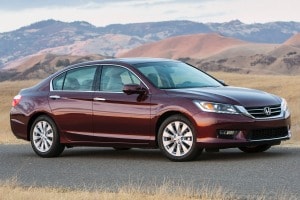
The 2013 Honda Accord represents the start of the ninth generation. And for once, it's not bigger and heavier than the one it replaces. This is likely a response to criticism that the previous Accord had become too large and too soft. As such, this slightly smaller successor not only boasts segment-leading fuel economy but also marks a return to the sporty driving dynamics of much earlier Accords.
Within the less bulky styling is an improved interior with a more cohesive design and higher-quality materials. The switchgear is less confusing than before and the HondaLink system allows connectivity for audio streaming and social media as well as iPhone and Android apps. And despite the newest Accord measuring nearly 4 inches shorter in length, there is more rear seat legroom and trunk capacity. Trim levels are the familiar base LX (sedan only), luxury EX, leather-lined EX-L and leather-and-navigation-equipped EX-L with Navi. New trims include the enthusiast-oriented Sport (sedan), loaded Touring (sedan) and LX-S (essentially the LX version of the coupe).
Under the hood, direct injection debuts for the standard 2.4-liter four-cylinder engine, adding power (now up to 185-189 horsepower) and greater fuel efficiency. Although a six-speed manual transmission is standard on nearly all four-cylinder Accord trims, most will likely be fitted with the optional continuously variable automatic transmission (CVT). The available 3.5-liter V6 provides 278 hp and is backed by a conventional six-speed automatic in all trims except for the EX-L coupe, where it can also be matched to a six-speed manual transmission.
In reviews, this Accord impresses with its more agile demeanor, spirited acceleration (with both engines), refined CVT performance, excellent fuel economy and roomy, comfortable cabin. The Accord's crisp handling should delight even those who don't consider themselves driving enthusiasts, as the car simply drives smaller than it is. However, the ride is on the firm side, which may not suit those used to a plusher ride in their family sedan or coupe. Overall, this is the best Accord we've seen in quite some time -- no small accomplishment considering how consistently well-regarded this segment staple has been.
Used Honda Accords
The previous-generation Accord -- which ran from 2008-'12 -- was bigger than prior models, yet boasted better engine performance without any loss of fuel efficiency. As before, it was available as a midsize coupe or sedan and in a variety of trim levels to suit almost any buyer's needs. Entry-level LX versions provided the basic amenities while the top-of-the-line EX-L featured items like leather upholstery, Bluetooth and an optional navigation system. All Accords came with a full array of safety equipment, including side curtain airbags and stability control.
Once again, engine choices consisted of a 2.4-liter inline-4 (with 177 hp for LX trims and 190 hp for EX trims) and a 3.5-liter V6 with 271 hp (268 hp for '08). The four came with a five-speed manual transmission as standard and a five-speed automatic as optional. The V6 sedans came with a five-speed automatic, though V6-equipped coupes also were available with a six-speed manual. The most notable changes to this generation took place for 2011, when it saw a bump in fuel economy and the availability of previously lacking features, such as an iPod/USB interface, a rearview camera and shift paddles for the automatic transmission.
In reviews, we found this generation to be a satisfying family sedan or midsize coupe, despite increased competition from numerous rivals. Strong points included a roomy cabin, an agreeable ride/handling balance, crashworthiness and reliability, while points were deducted for a button-happy dash, merely average materials quality (previous Accords were known for high-quality cabins), noticeable road noise and mediocre braking performance.
Many other used Honda Accords you'll encounter will represent the vehicle's seventh generation -- the 2003-'07 model years. It was available as a midsize coupe or sedan and picking an Accord from this generation should be rather straightforward. Initially, there were three trim levels: DX, LX and EX. The DX was pretty sparse with features, so an LX or EX would be a better choice. Side and side-curtain airbags were typically optional on all trim levels.
Under the hood was a 160-hp 2.4-liter inline-4 or a 240-hp, 3.0-liter V6 engine. Four-cylinder engines could be had with either a five-speed manual or five-speed automatic transmission. A six-speed manual was available on the V6-powered EX Coupe.
In 2005, Honda introduced the Accord Hybrid. This model's V6 gasoline/electric powertrain produced 255 hp and, in theory, the best fuel economy of the lineup. In real-world use, however, the car's fuel economy was disappointing and people balked at its higher price. Very few Accord Hybrids were sold.
The most significant changes of this generation occurred in 2006 when the Accord received freshened exterior styling and more power for both engines. Stability control also debuted this year, as did minor modifications to trim level organization. In reviews we praised the car for its roomy and stylish interior, tight build quality, smooth ride and good crash test scores. Downsides included tepid handling and mediocre brakes. All said, however, this Accord was an excellent choice for a family sedan or midsize coupe.
The sixth-generation Honda Accord is also very popular in the used car market. Available from 1998-2002, this model came in coupe or sedan body styles and had either four-cylinder or V6 power. In a nine-car comparison test conducted by our Edmunds.com editors, this car finished in 2nd place. We noted that the car was not exactly entertaining to drive but was very user-friendly and competent in all areas. Buyers should feel relatively free to look at models throughout this generation as Honda didn't make any drastic changes, though cars built after 2000 have expanded safety features.
A well-kept Accord built from 1994 to 1997 should make for a smart choice for those on a budget. This model boasted the typical Accord attributes and, as a used car, should provide better than average reliability, assuming it's been properly maintained by previous owners. This generation marked the first time that Honda used its VTEC variable valve timing system. A VTEC-equipped four-cylinder engine came with the EX trim level. Accord models from 1995 and upward also had a V6 available. This generation was also the last for the rare Accord wagon.

Honda Civic Review

Since its launch in 1973, the Honda Civic has been one of the most popular compact cars sold in America. Its success can be attributed to its consistently high level of fit and finish and an impressive, long-standing reputation for reliability and low running costs. High fuel economy, environmental awareness and engaging performance have also played a large role in making the Honda Civic a top choice for many Americans.
The latest Honda Civic isn't really a no-brainer choice as its forbearers were, but it still comes recommended thanks to its clever interior, wide range of models and aforementioned strong reputation. For small car shoppers looking for a used vehicle, the Civic is certainly a smart choice, as its long production run and wide range of models make it easy to find what you want.
Current Honda Civic
Redesigned for 2012, the Honda Civic is again available as a coupe or sedan. Mainstream trim levels consist of the familiar DX, LX, EX and EX-L, with standard equipment levels increasing throughout to include heated leather seats in the EX-L trim. There are also the Hybrid sedan, Natural Gas sedan and Si coupe/sedan. A new "HF" (High Fuel efficiency) version is also available, with gas-saving features such as low-rolling-resistance tires and subtle aerodynamic tweaks.
The powertrain for the DX, LX and EX versions is unchanged, meaning a 1.8-liter, 140-horsepower inline-4 matched to either a five-speed manual or five-speed automatic. The Hybrid has a more powerful electric motor than before (resulting in a total output of 110 hp) mated to a continuously variable transmission (CVT) and boasting improved fuel mileage ratings (44 mpg in combined driving). The clean-burning Natural Gas model puts out 110 hp, while the Si sports a larger (2.4-liter) engine for this year, which provides greater output (201 hp) as well as the promise of a broader power spread. The Si is only available with a six-speed manual transmission.
The exterior styling is a subtle evolution of the previous form, with more sharply chiseled body sides. The cabin is likewise similar to before, with intuitive controls and a new multifunction display. Sadly there's more low-grade plastic trim than what's seen in some of the Civic's rivals that now have notably more upscale interior materials.
Overall, this Civic is still a pretty capable small car. Its generous selection of engines and configurations should help it appeal to a wide variety of shoppers, while typical small Honda traits like nimble handling and high fuel economy remain intact. However, many other new small cars that also offer these traits are arguably more desirable to own. This Civic is a solid pick for a small coupe or sedan, but we do suggest shopping other top competing models as well.
Used Honda Civic Models
Prior to the current model, Honda sold the eighth-generation Civic from 2006 through 2011. It'll be the most common used Civic you'll probably come across, and overall it should be a great pick for a used small car.
For this generation, Honda offered the Civic in coupe and sedan body styles with the usual base DX, well-equipped LX, loaded EX, leather-lined EX-L and sporty Si main trim levels. In addition to the mainstream trims, there were also the Hybrid and GX (natural gas) trim levels.
All trims had a broad range of safety features, such as antilock brakes, front-seat side airbags and full-length side curtain airbags, although stability control could only be had on the EX-L, Hybrid and Si trims. The standard DX trim was pretty bare-bones in terms of premium features, so you'll have to jump up to the higher trims to get amenities such as air-conditioning and full power accessories.
Only minor updates occurred during this car's run. The Si sedan debuted for '07, while the following year saw a limited-edition Mugen Si model and the addition of a leather upholstery option. For '09, the LX-S and DX Value Package trims debuted along with a minor exterior refresh. For the final two years, the Civic continued on essentially unchanged.
All Civics but the Si had a 1.8-liter, 140-hp four-cylinder engine paired with a five-speed manual transmission; a five-speed automatic was optional. The Civic Si, offered in both coupe and sedan body styles, featured a high-revving 2.0-liter, 197-hp four-cylinder engine matched to a close-ratio six-speed manual transmission.
The Civic GX featured a 113-hp 1.8-liter four-cylinder engine that ran on clean-burning compressed natural gas. The Civic Hybrid came with a 1.3-liter four-cylinder gas engine and a 20-hp electric motor. Total output was 110 hp. The Hybrid had an exclusive CVT and earned EPA-estimated fuel economy ratings of 40 mpg city and 45 mpg highway.
The coupe was tuned to feel sportier than the sedan, but both are fun to drive, with quick steering and impressive handling. The 1.8-liter engine won't overwhelm anyone, but it provides enough power for comfortable everyday driving. The Hybrid gets fantastic fuel mileage and the GX is impressively clean, but both suffer from slow acceleration.
In reviews and road tests, our editors found this Honda Civic to be a well-rounded car, and it should be a top pick for anybody shopping in this segment. Thanks to the wide array of configurations, it should also be easy to find a Civic that meets your needs. The only major downsides include elevated road noise and a controversial dash layout.
Previous to the 2006-'11 model was the seventh-generation Honda Civic, which was sold from 2001-'05. There were coupe and sedan body styles as well as a two-door hatchback. Honda offered its typical mainstream trims -- DX, LX and EX -- plus a few specialty trims such as VP, HX, SE and Hybrid. The hatchback came only in the Si trim. Most models had a 1.7-liter engine good for 117 hp or 127 hp (EX). The Civic Hybrid mated an 85-hp 1.3-liter four-cylinder gas engine to a 13-hp electric motor and offered the best fuel economy of the lineup. The Civic Si produced 160 hp from its 2.0-liter engine. At the time, we commented favorably about the car's fuel-efficient engines, roomy interior and top safety scores but were disappointed by the limited availability of antilock brakes.
Sold from 1996-2000, the sixth-generation Civic was in many ways a refinement of the style and technology found on the previous generation. Coupe, sedan and hatchback body styles were available. Sedans were offered in DX, LX and EX trim levels. Engine choices were a 1.6-liter good for 106 hp in the DX and LX or 127 hp in the VTEC-equipped EX. There was also a higher-fuel-economy coupe, the 115-hp HX. Honda didn't release an Si trim until 1999. Based on the coupe body style, the Si was powered by a high-performance 1.6-liter engine tuned to put out 160 hp.
Honda's VTEC technology first appeared in the fifth-generation Civic, which was sold from 1992-'95. The Civic VX featured a fuel-efficient 92-hp 1.5-liter four-cylinder with VTEC-E. More powerful was the 125-hp 1.6-liter four-cylinder VTEC engine found in the Civic Si and EX sedan trims. First sold only in hatchback and sedan body styles, the fifth-gen Honda Civic got two coupe trims in 1993, the DX and EX. The lower CX and DX trims each had a 70-hp 1.5-liter four-cylinder engine.

Suzuki Aerio Review

Despite spending an impressive six years on the market -- and enjoying advantages like a roomy cabin and available all-wheel drive -- the compact Suzuki Aerio remained nearly invisible to most consumers. If you ask us, it probably had something to do with the Aerio's average-at-best overall report card. To use a football analogy, it was like a second- or third-string specialty player that Suzuki forced to suit up against several heavy-hitting, all-purpose first-stringers. This wasn't a game the Aerio was likely to win -- yet it was a better car than its sales numbers and anonymity would suggest.
Most Recent Suzuki Aerio
The compact Suzuki Aerio debuted in 2002 as a sedan and four-door hatchback wagon. Initially, there were S and GS (later called LS) trim levels for the sedan; the hatchback came in SX trim only. Later Aerios were offered in either base or Premium trims. Versatility was always a strong point for the hatchback -- with the rear seats folded down, it could carry an impressive 64 cubic feet of cargo.
Aerios were initially powered by a 2.0-liter inline four-cylinder engine; displacement was later bumped to 2.3 liters, with a commensurate increase in power. A five-speed manual transmission was standard on entry-level cars, while a four-speed automatic was optional on those models and standard on higher trim levels. The Aerio was available in either front-wheel or, beginning in 2003, all-wheel drive.
With either transmission, the Suzuki Aerio was sufficiently responsive for running errands around town or commuting. However, although the Aerio provided a soft, smooth ride on the highway, we found there was a penalty to be paid: excessive body roll around corners, which was exacerbated by the car's relatively tall, tippy stance. Opting for AWD settled things down a bit, and of course it improved the Aerio's traction in wet weather as well. Indeed, that optional all-weather capability was one of the few compelling features the Aerio had to offer.
Thanks to its high roof line, the Suzuki Aerio boasted a surprising amount of interior room for its size, and we found ingress and egress to be an all-around cinch. The Aerio offered a generous 14.6 cubic feet of trunk space, too. Unfortunately, interior plastics quality, execution and overall refinement were below average compared to the economy class leaders.
Some notable changes occurred after the Aerio's debut. In 2003, it received a slight power boost to 145 horsepower (from the initial 141 hp) and minor interior trim refinements; uplevel GS and SX models got a six-disc CD player and could be had with all-wheel-drive traction. The 2.0-liter engine was replaced by a 2.3-liter unit in 2004, and horsepower rose to a rather impressive 155. Suzuki added more standard features in 2005 and redesigned the instrument panel, which we had previously criticized as having hard-to-read gauges and a lack of storage compartments. The wagon was dropped for 2007, leaving the sedan to finish out the Aerio's production run by itself.
As a used car, the Suzuki Aerio does have a few things going for it. Its attractive price when new looks even better now that depreciation has taken its toll, and its peppy engine and optional all-wheel drive were pleasant qualities. But the Aerio was never particularly enjoyable to drive and generally came up short in terms of refinement and features.

Suzuki Kizashi Review

Suzuki is renowned for its desirable motorcycles, but its cars historically haven't enjoyed nearly the same respect. The Suzuki Kizashi midsize sedan is a serious attempt to bring the company's automotive division up to snuff. Billed as a sophisticated sport sedan at a family-sedan price, the Kizashi generally delivers. It looks sharp, it drives well and its interior is one of the nicest in the segment.
While the Kizashi is billed as midsize, its dimensions actually fall in between that segment and increasingly large compacts. This means it's in the unique position to compete against both camps. It's larger, more luxurious and better built than most compacts, yet less expensive and more agile than the midsizers. We think it's definitely worth a look, but the biggest obstacle could be finding one given Suzuki's limited dealer network.
Current Suzuki Kizashi
The Suzuki Kizashi sedan is powered by a 2.4-liter four-cylinder engine that produces 185 horsepower and 170 pound-feet of torque. Front-wheel drive is standard, with all-wheel drive optional. It comes in S, SE, Sport GTS and Sport SLS trim levels. A six-speed manual transmission is standard on the S, Sport GTS and Sport SLS with front-wheel drive, while a continuously variable transmission (CVT) is optional on those trims and standard on the SE and all-wheel-drive models.
Standard equipment on the base model is impressive, including keyless ignition/entry, full power accessories, dual-zone automatic climate control, a USB/iPod interface and satellite radio. Higher trims net features like alloy wheels, power seats, a sunroof, leather upholstery, steering wheel shift paddles (for the CVT), a Rockford Fosgate sound system and Bluetooth. The Sport trims get cosmetic, aerodynamic and suspension enhancements.
The Suzuki Kizashi's design is an interesting mix of familiar and novel elements. Some people might see some Volkswagen influence in the car's exterior styling, but otherwise the Kizashi is its own beast. Inside, there's an attractive dashboard design with tastefully restrained metallic accents and upscale materials. Nice touches abound, such as standard keyless ignition and cushioned chrome-ringed door handles. The backseat has plenty of room for two full-size adults, and the relatively high seat cushion actually makes the Kizashi more comfortable for long-legged rear passengers than some larger rivals.
In reviews, we've praised the Suzuki Kizashi for emulating the sophisticated driving dynamics of Japanese and European sport sedans at a fraction of their price. Grip is ample in corners, the ride is supple yet well-controlled and the steering is a bit lacking in feel but nicely weighted. Wind and road noise are kept in check on the highway, and the Kizashi has a sense of straight-ahead that's uncommon for a car starting under $20,000. The four-cylinder engine is the closest thing to a weak link here -- it's plenty peppy for normal use, but those expecting the Kizashi's power to match its sport-sedanlike handling may be disappointed, particularly if they select the CVT.
Used Suzuki Kizashi Models
The Suzuki Kizashi was new for 2010. In that first year, the Sport GTS and Sport SLS lacked the "Sport" prefix as well as the associated cosmetic, aerodynamic and suspension enhancements.

Suzuki SX4 Review

While Suzuki makes class-leading motorcycles that are desired from Okinawa to Omaha, its luck in the automobile market has been less than stellar. Most of its models were rebadged Daewoos when the Suzuki SX4 was introduced. This compact car proved the small Japanese company could make better cars when it took on the project itself. While it's not quite as fun as Suzuki's two-wheeled vehicles, the SX4 is nevertheless a thoroughly competent and well-made small car.
Considering that Americans still overwhelmingly prefer sedans to hatchbacks, the sedan model gives the Suzuki SX4 an advantage over other subcompact cars that are offered only with a hatch. The available all-wheel drive on the hatchback also gives the SX4 a decided advantage, as do both models' impressive build quality and sporty styling. However, its 143-horsepower four-cylinder engine struggles with the hefty curb weight, and fuel economy is consequently below average as a result. If your top priority is having a fuel-sipping compact, the SX4 is not the best choice. Yet while other subcompacts may lean toward either sportiness or comfort, the Suzuki SX4 does a good job of providing both, with the added bonus of all-wheel drive and a sedan model.
Current Suzuki SX4
The Suzuki SX4 is offered in four-door hatchback and four-door sedan body styles, which are split into two different styles. The sedan can be had in a no-nonsense economy car guise as well as a "Sport" series of trims that feature different suspension turning and styling. The hatchback is available as the sporty "Sportback" or the SX4 Crossover for those seeking a more rugged compact car with available all-wheel drive, SUV-like body cladding and a taller ride height.
Underneath its sporty exterior lies a platform shared with the previous-generation, award-winning Suzuki Swift sold in Europe and Japan. This translates into a car with ride and handling characteristics seemingly fashioned for those locales. The ride is on the firm side, but in an upscale sort of way, absorbing bumps and undulating pavement with impressive composure. Its steering is also tight and direct, offering one of the more fun driving experiences in this segment.
For those in colder climes, the SX4 Crossover should prove attractive, as it is the least expensive all-wheel-drive car on the market. Featuring three modes, the AWD system can be configured for maximum traction or fuel economy. AWD Auto is like many crossover SUV systems that shunt power to the rear wheels only when front-wheel slippage is detected. AWD Lock is for lower speeds through snow or mud, while FWD mode is best for fuel economy. In most cases, that's the mode of choice, since neither body style achieves good fuel economy numbers for this class.
Picking the right SX4 for you can be tricky, as there are a multitude of trim levels available. The range starts off with the base sedan, which is scarcely appointed with full power accessories, a height-adjustable driver seat, a tilt steering wheel and a 60/40-split-folding rear seat. Added niceties available on both the upper sedan and Sportback trims include air-conditioning, a four-speaker sound system, cruise control, automatic climate control, Bluetooth, keyless ignition/entry and an integrated Garmin navigation system. The "Sport" sedan options include a sport-tuned suspension, 17-inch alloy wheels, four-wheel disc brakes and an aero body kit.
The interior is one of the Suzuki SX4's best attributes, sporting a simple, user-friendly design and decent materials. Although not as versatile as some other subcompact hatchbacks, the SX4 does offer plenty of rear passenger room and cargo space thanks to a flip-and-fold backseat that's placed high atop the floor for so-called "stadium seating."
Used Suzuki SX4 Models
The Suzuki SX4 debuted for the 2007 model year. Changes since then include the addition of the front-wheel-drive SX4 Sport sedan in '08; in its first year of production, the SX4 was offered only as an all-wheel-drive hatchback. Model-year 2009 saw the arrival of a front-wheel-drive hatchback (known as "Crossover"), a split-folding rear seat for the sedan and a standard navigation system on upper trim levels.
For 2010, Suzuki added the SX4 Sportback model and power was ever so slightly increased from 143 hp to 150. New transmissions -- a six speed manual and continuously variable (CVT) -- replaced the previous five-speed manual and four-speed automatic, improving fuel economy A restyled front fascia, new gauges, a height-adjustable driver seat, an auxiliary audio jack, a few new navigation features and some renamed trim levels also debuted for 2010.
It's important to note that every SX4 got standard stability control for 2012. Previously, it was only available on upper trim levels. For 2011 only, rear drum brakes came on the base and LE trims.

Suzuki Vitara Review

By the late 1990s, the major Japanese automakers had established a new design direction for compact SUVs by introducing models with car-based platforms for enhanced comfort and efficiency. However, Suzuki had been in the cute-ute business longer than almost anyone, and when the time came to replace its long-running Sidekick, Suzuki stuck to its traditions for the then-new Vitara.
Essentially, the Suzuki Vitara was born with the roots of a truck. Instead of adapting new, lighter unibody construction, the Suzuki maintained a rugged body-on-frame design. Every Vitara rode on a solid-rear-axle suspension and came with either rear-wheel drive or four-wheel drive with low-range gearing. Thanks to 8 inches of ground clearance, 4WD models possessed better-than-average off-road ability. An available two-door convertible body style also made it possible to equip a Vitara as a fun-in-the-sun runabout, and responsive steering made it enjoyable on any surface.
Still, the Suzuki Vitara had too many detriments weighing it down in real-world driving. Slow acceleration was a problem with either of the small four-cylinder engines, and a hard-to-shift manual transmission didn't help. The low-tech suspension could never absorb bumps very well, the rear seat was cramped (space was identical in both body styles) and cargo capacity was a modest 45 cubic feet even on the four-door. Finally, the interior looked dated even when new, and some of its controls weren't user-friendly.
Suzuki raised the Vitara's standards in power and features over time, but at both the beginning and end, we'd still say Honda, Toyota and Subaru had better SUVs for the street, while Nissan and Jeep had better off-roaders.
Most Recent Suzuki Vitara
While the upscale Grand Vitara lived to see another generation, the regular Suzuki Vitara led one lifetime spanning from 1999-2004. Body styles included a four-door hardtop and a two-door convertible soft top that was shorter than the four-door by 11 inches in both length and wheelbase. A 1.6-liter four-cylinder with 97 horsepower was the base engine on two-doors; a 2.0-liter version with 127 hp was optional on the two-door and standard with the four-door. Both engines came with a five-speed manual or four-speed automatic, with shift-on-the-fly four-wheel drive optional with any combination.
The Vitara's initial trim lines were JS (2WD) and JX (4WD), though by its second year that expanded with the JLS and JLX, which became the only models with power windows, power locks, air-conditioning, and on the four-door, cruise control. Among two-door Vitaras, the JLS and JLX were also significant for having the more tolerable 2.0-liter engine.
Many details changed over the years. Along with the trim line changes for 2000, the two-door Vitara earned standard air-conditioning. For model-year 2001 came a new grille, seat fabric and an easier-to-use stereo. In 2002, the JS and JX got dropped completely and took their 1.6-liter engine with them, trimming the Vitara line down to JLS 2WD and JLX 4WD models. All trim lines vanished for 2003, and only the four-door model made it to the Vitara's final year in 2004, when a 165-hp 2.5-liter V6 became the new engine.
If you feel compelled to buy a Suzuki Vitara, later is better: The improved content and ergonomics of more recent models make for a more appealing SUV. Regardless of year, try sticking to models with at least the 2.0-liter engine, whose 127 hp is just enough
 
Support : Cah Ganteng | Johny Template | Mas Template
Copyright © 2011. Car Reviews - All Rights Reserved
Template Modify by Creating Website
Proudly powered by Blogger
url submit